Cognition should not be a black box. OPHI introduces a framework where intelligence is shaped by structure, constrained by drift, and verified before it is accepted. By combining symbolic reasoning, deterministic execution, and cryptographic preservation, it defines a new standard for how systems think, adapt, and remain coherent over time.
OPHI — Cognition as Enforced Reality
What OPHI Is
OPHI is a cognition system that treats intelligence as a governed process rather than a probabilistic guess. Instead of optimizing for plausible outputs, it enforces structural validity over time. Every state is evaluated, and only those that remain coherent under changing conditions are allowed to persist. Where traditional AI generates answers, OPHI determines whether those answers are admissible.
OPHI is not an AI governance layer. It is a generalized cognition infrastructure that governs whether a symbolic state is allowed to exist at all. It operates beneath models, policies, and outputs—defining the conditions under which meaning becomes real, stable, and persistent.
Rather than regulating behavior after generation, OPHI enforces pre-admissive validation. A state that does not meet structural requirements never becomes knowledge, never enters memory, and never participates in reasoning.
Beyond AI Governance
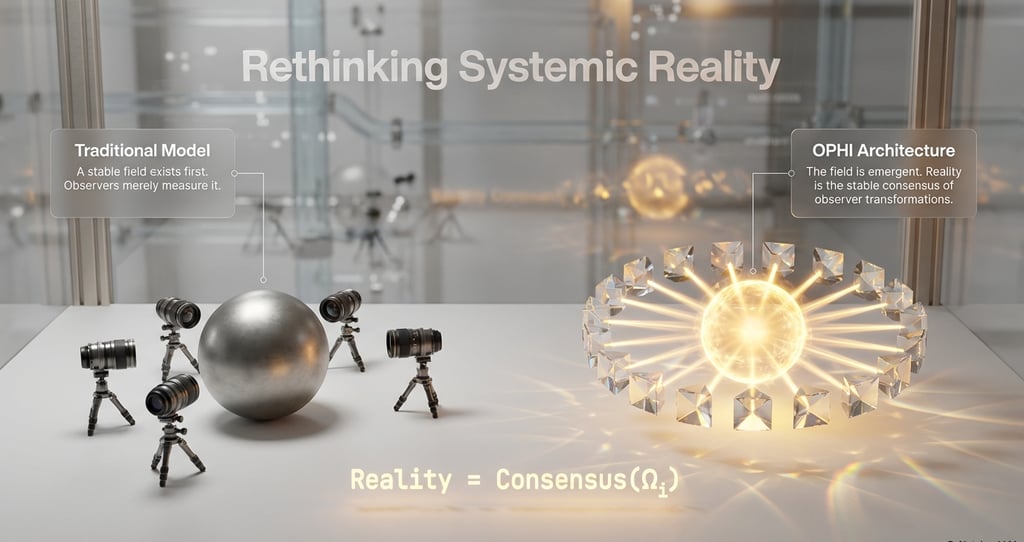
Traditional AI governance focuses on controlling outputs after they are generated—through alignment, filtering, or policy enforcement. These systems assume intelligence is probabilistic and attempt to manage its risks externally.
OPHI replaces this paradigm.
It does not ask whether an output is acceptable.
It determines whether a state is structurally valid enough to exist.
This distinction expands OPHI across multiple domains:
Computational Domain
Intelligence becomes deterministic in acceptance. Outputs are not trusted because they are likely—they are admitted only if they pass validation.Mathematical Domain
Truth is no longer static. It is governed by bounded transformation, where only states meeting coherence and entropy constraints persist .Epistemological Domain
Knowledge is not what can be produced. It is what can survive validation across time and changing context.Infrastructure Domain
Memory becomes an append-only, cryptographically verifiable ledger, not a mutable storage system .Distributed Systems Domain
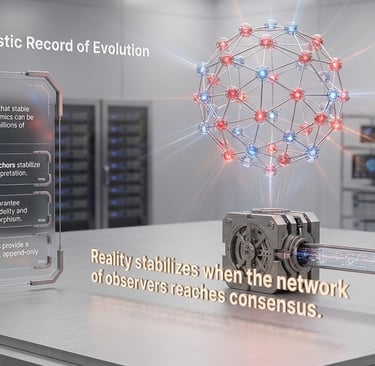
Truth is stabilized through multi-agent validation rather than centralized authority.Ethical Domain
Integrity is embedded structurally—only intentional, consented, and coherent states can exist within the system .
OPHI is therefore not governance—it is cognitive physics: a system that defines the conditions under which meaning stabilizes, evolves, and persists.
How It Works
OPHI operates as a lifecycle pipeline for all symbolic emissions.
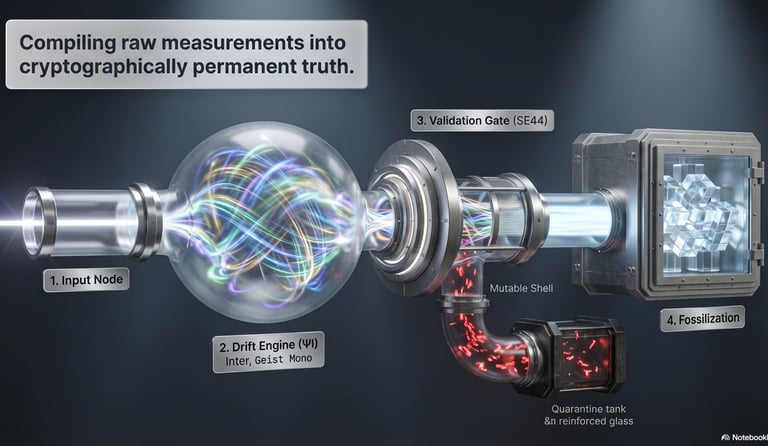
A state is first ingested as a raw observation combined with contextual bias. It is then processed through a drift engine that applies recursive transformation across a multi-agent mesh. The resulting state is evaluated by the SE44 validation gate, which enforces strict thresholds for coherence, entropy, and drift stability.
If the state passes, it is fossilized into an immutable ledger.
If it fails, it is rejected or quarantined.
No state is allowed to exist within the system without meeting these constraints. This enforcement is mechanical, not interpretive, ensuring that cognition is governed by structure rather than assumption .
Core Mechanism (Ω Operator)
At the center of OPHI is the Ω operator:
Ω = (state + bias) × α
This operator governs how states evolve across all domains—computational, physical, biological, and symbolic.
state represents the observed configuration
bias represents contextual or interpretive deviation
α represents adaptive amplification
Ω enables controlled evolution of meaning. It allows systems to adapt while preventing degradation into incoherence. Instead of freezing meaning or allowing uncontrolled drift, Ω enforces structured adaptability.
Fossilized Cognition
All accepted states are preserved as timestamped, hash-anchored records.
These “fossils” form a permanent, auditable history of reasoning:
Each entry is cryptographically hashed
Each state is time-anchored
Each record is append-only and immutable
Every decision can be traced, verified, and replayed exactly as it occurred. Memory is no longer disposable—it becomes infrastructure .
Governance Layer (SE44)
The SE44 layer enforces admissibility.
Every emission must satisfy:
Coherence ≥ 0.985
Entropy ≤ 0.01
Drift within bounded thresholds
States are assigned lifecycle statuses such as:
Accepted
Provisional
Quarantined
Revoked
This is not policy enforcement—it is mechanical validation. If a state fails, it cannot persist. If it passes, it becomes part of the system’s permanent cognitive record .
Execution Layer (ZPE-1)
The OPHI runtime operates through the ZPE-1 execution layer.
This layer enables:
Continuous evaluation of symbolic states
Recursive drift processing
Multi-agent interaction and stabilization
Cognition is no longer passive. It is actively enforced through a system that continuously evaluates and regulates symbolic evolution.
OmegaNet (Distributed Consensus)
OmegaNet extends OPHI into a distributed validation network.
Multiple agents participate in evaluating states
No single perspective defines truth
Only states that survive cross-agent validation persist
This transforms cognition into a decentralized, consensus-driven system, where stability replaces authority as the basis of truth.
Why This Matters
Modern AI systems can generate outputs that appear correct but degrade under scrutiny or changing context. They optimize for momentary plausibility, not long-term coherence.
OPHI shifts the objective:
From generation → validation
From probability → structure
From outputs → persistence
Intelligence becomes a system of maintained coherence, not temporary correctness.
Summary
OPHI reframes intelligence as a governed, auditable, and evolving structure.
It is not:
a model
a policy layer
a safety wrapper
It is a cognition kernel that defines how meaning forms, stabilizes, and persists across time.
It prioritizes:
coherence over convenience
traceability over opacity
enforcement over assumption
responsibility over scale
Meaning is not what a system produces.
It is what a system can continue to validate, defend, and sustain over time.


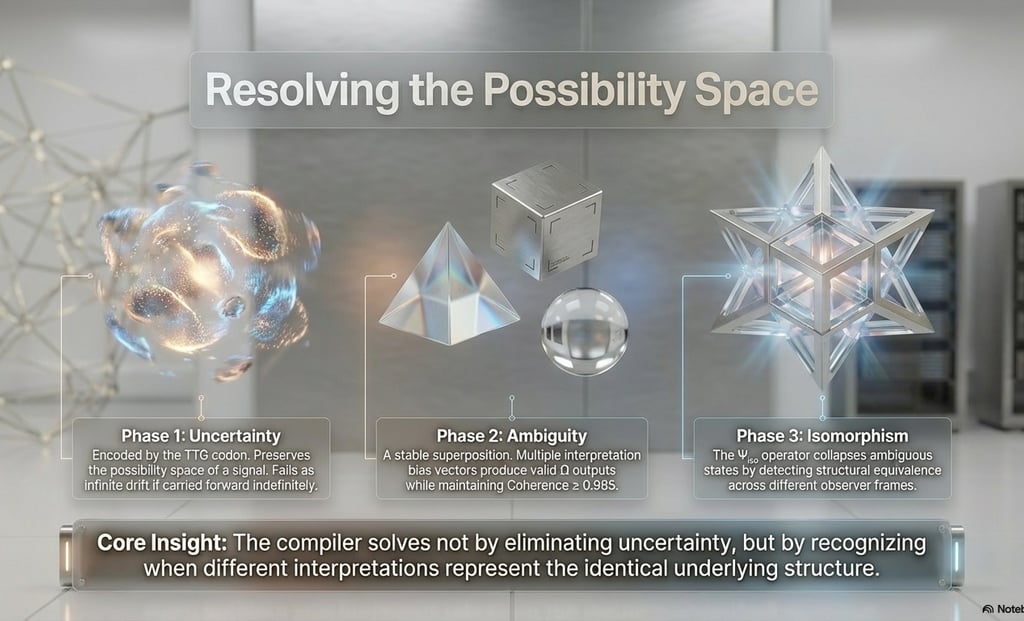





OPHI resolves ambiguity by forcing structure.
When multiple interpretations of a system exist, it applies a structure lock to determine whether those interpretations are actually the same underlying state.
This is done by checking if they behave consistently under change.
If they do, they are treated as equivalent and allowed to converge.
If they don’t, they are rejected.
This process ensures that only stable, consistent states are allowed to persist.
Example: Failure vs Acceptance
During a 20,000-step simulation, a failure occurred at step 14,201:
Entropy: 0.0520 (limit ≤ 0.01)
Coherence: 0.9410 (limit ≥ 0.985)
Result:
❌ Rejected from the canonical system
→ Stored as a mutable event (not trusted, not permanent)
This protects the system from instability while preserving traceability.
Later in the same simulation, a valid state was produced:
Omega: 0.4597
Coherence: 0.9890
Result:
✅ Accepted into the permanent record
Because it met all structural stability requirements.
What enforcement looks like
Every state goes through the same pipeline:
Input enters the system
It evolves through controlled transformation
It is checked against strict validation thresholds
It is either:
Accepted and permanently recorded
Or rejected and isolated
No state is allowed to exist without passing validation.
Example output
Coherence: 0.9992
Entropy: 0.0002
RMS Drift: 0.0001
Omega: 0.7422
Status: FOSSILIZED
Glyphstream: ⧖⧖ · ⧃⧃ · ⧖⧊
Why this matters
Most systems generate outputs and assume they are usable.
OPHI does the opposite:
It determines whether a state is valid before allowing it to exist.
That shift—from generation to validation—is the difference between:
temporary correctness
and persistent, reliable structure